World's highest railway bridge builder loses tax claim after court limits review power
The Supreme Court restored an arbitral award denying Rs 1.37 crore tax reimbursement, ruling that appellate courts cannot re-interpret contracts just because another view is possible.
9
years.
The Supreme Court restored an arbitral award denying Rs 1.37 crore tax reimbursement, ruling that appellate courts cannot re-interpret contracts just because another view is possible.
A contractor built the world's highest railway bridge. Then the tax exemption vanished. The arbitrator said: you pay. The High Court said: no, the contract says otherwise. The Supreme Court just picked a side — but not the one you'd expect.
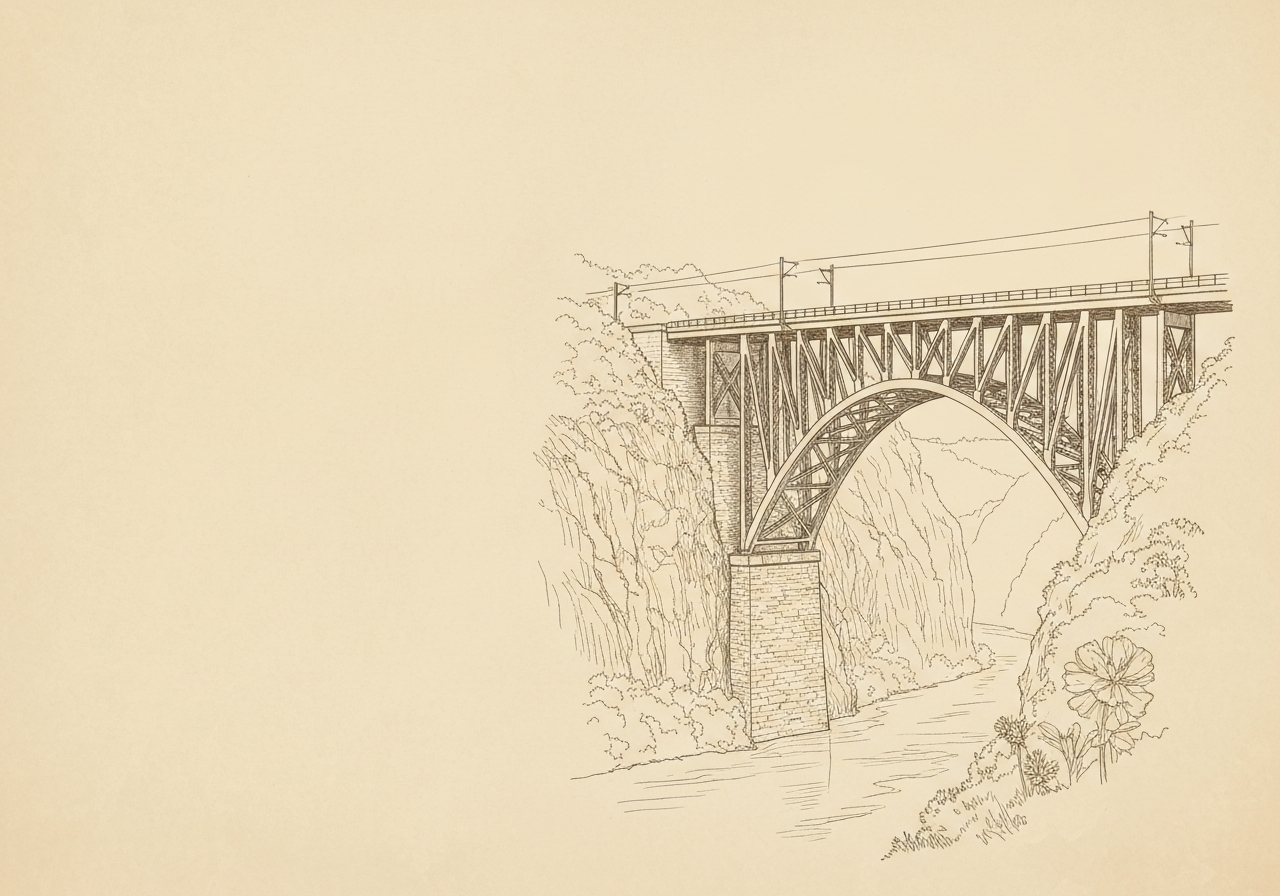
The bridge is described as the highest railway bridge in the world, a steel arch on the Katra-Laole section of the Udhampur-Srinagar-Baramulla rail link. Konkan Railway Corporation Limited hired the Chenab Bridge Project Undertaking to build it, signing the contract in November 2004. Then the Jammu & Kashmir government withdrew a tax exemption on earth-moving equipment — Entry Tax — and raised Toll Tax rates on machinery and materials. The contractor demanded reimbursement. Konkan Railway refused. The dispute landed before an arbitral tribunal.
The question the Supreme Court had to answer: when an arbitrator interprets a contract and a court thinks another interpretation is possible, can the court replace the arbitrator's view with its own?
The answer, delivered in Konkan Railway Corporation Limited v. Chenab Bridge Project Undertaking, was a firm no — and it came with a reminder of just how narrow the appellate window under the Arbitration Act really is.
When the tax exemption disappeared
The contract had two clauses at the centre of the fight. Clause 5.1.2 dealt with taxes and duties. Clause 7.1.1 and 7.1.2 covered price variation — the mechanism for adjusting payments when costs changed. The contractor argued that when the government withdrew the Entry Tax exemption and raised Toll Tax, those were new costs that Konkan Railway should reimburse. The total claim: Rs 1,32,29,771 for Entry Tax and Rs 5,23,279 for increased Toll Tax.
The Standing Arbitral Tribunal — a panel set up by agreement dated 28 February 2012 — rejected every claim on 15 November 2014. The tribunal room, one imagines, was quiet as the award was read: the contractor's claims had failed entirely. The tribunal read Clause 5.1.2 narrowly: it covered only taxes that the contractor directly charged Konkan Railway on bills, not indirect taxes that formed part of the rates quoted in the Bill of Quantities (the detailed cost breakdown in the contract). The price variation clauses, the tribunal said, barred individual item-wise tax reimbursement. The contractor had already been compensated for cost changes through the price variation mechanism. Asking for tax reimbursement on top of that would be double recovery.
The physical contract document, with its disputed clauses, sat at the heart of every argument that followed.
The single judge said: the arbitrator's view is possible
The contractor challenged the award before a Single Judge of the Bombay High Court under Section 34 of the Arbitration and Conciliation Act, 1996 (the provision that allows a court to set aside an arbitral award on limited grounds like fraud, bias, or violation of public policy). The Single Judge dismissed the challenge on 17 January 2019. The arbitrator's interpretation of the contract, the judge said, was a plausible one. The court's job under Section 34 was not to decide which interpretation was better — only whether the arbitrator's view was so unreasonable that no reasonable person could have reached it. This one was not.
That should have been the end. But the contractor appealed under Section 37 of the Act (the provision that allows a party to appeal a Section 34 decision to a Division Bench of the High Court).
When the Division Bench rewrote the contract
The Division Bench of the Bombay High Court reversed the Single Judge on 23 September 2022. It reinterpreted the contract using two legal tools: ejusdem generis (a rule of interpretation where general words following specific words are limited to the same kind) and harmonious construction (reading clauses together so they don't contradict each other). The Division Bench concluded that the arbitrator had failed to give effect to all the clauses of the contract. The contractor, the Bench said, was entitled to reimbursement.
The courtroom fell silent as the judgment was delivered — the Division Bench had effectively rewritten the contract that the arbitrator had already interpreted.
Konkan Railway appealed to the Supreme Court.
The Supreme Court's answer: stay in your lane
The Supreme Court allowed Konkan Railway's appeal on 17 August 2023, restoring the Single Judge's order and the original arbitral award. The bench — Chief Justice D.Y. Chandrachud, Justice P.S. Narasimha, and Justice J.B. Pardiwala — delivered a crisp ratio (the court's central reasoning) that every commercial litigator needs to memorise.
The scope of interference under Section 37, the court said, is restricted and subject to the same grounds as a challenge under Section 34. It is not a normal appellate jurisdiction where the court can re-examine the merits. The jurisdiction under Section 34 is exercised only to see if the Arbitral Tribunal's view is perverse or manifestly arbitrary (so obviously wrong that no reasonable person could agree with it). The question of reinterpreting the contract on an alternative view does not arise.
The court cited its own precedents — MMTC Ltd. v. Vedanta Ltd. (2019), Dyna Technologies Pvt. Ltd. v. Crompton Greaves Ltd. (2019), UHL Power Company Ltd. v. State of Himachal Pradesh (2022), South East Asia Marine Engineering and Constructions Ltd. v. Oil India Ltd. (2020), Patel Engineering Ltd. v. North Eastern Electric Power Corporation Ltd. (2020), Associate Builders v. Delhi Development Authority (2015), Vidya Drolia and Ors. v. Durga Trading Corporation (2021), and Ssangyong Engineering & Construction Company Ltd. v. NHAI (2019) — to drive home the point: where the Arbitral Tribunal's interpretation of contractual clauses constitutes a plausible view and has been affirmed by the Section 34 Court as reasonable, concurrent findings cannot be set aside under Section 37 merely because an alternative interpretation exists.
The bench's silence during oral arguments, broken only by pointed questions about the limits of appellate jurisdiction, foreshadowed the outcome. "A Division Bench under Section 37 cannot reverse an award or the Section 34 decision on the ground that the tribunal failed to give effect and voice to all contractual clauses," the court held.
The court also invoked Section 5 of the Arbitration and Conciliation Act (which limits the extent of judicial intervention) and Section 34(2) (which specifies the grounds for setting aside an award, including public policy) to reinforce the message: the Arbitration Act is designed to minimise court interference, not to create a second layer of merits review.
Why this matters for every construction contract
This judgment is a shield for award-holders and a warning for parties who lose before an arbitrator and hope the High Court will fix it. The Supreme Court has drawn a clear line: the appellate court under Section 37 is not a second arbitrator. It cannot re-interpret the contract because it thinks another reading is more elegant or more equitable. If the arbitrator's view is one that a reasonable person could hold, the court must leave it alone — even if the court would have decided differently.
The procedural journey itself tells the story. The Standing Arbitral Tribunal rejected all claims on 15 November 2014. The Single Judge upheld that award on 17 January 2019. The Division Bench partly reversed on 23 September 2022, allowing Disputes III and IV. The Supreme Court restored the original award on 17 August 2023. Nearly nine years of litigation, across four forums, to arrive back at the starting point — because the Division Bench exceeded its limited jurisdiction.
THE PLAY: When you lose an arbitration, do not assume the High Court will rescue you by re-reading the contract — the Supreme Court has now closed that door unless the arbitrator's interpretation is perverse or manifestly arbitrary.
The world's highest railway bridge stands. The tax claim does not.