Your phone's secret ID just nailed you. Here's how.
Every mobile has a unique IMEI number. The Supreme Court says that plus cell tower data can put you at the crime scene.
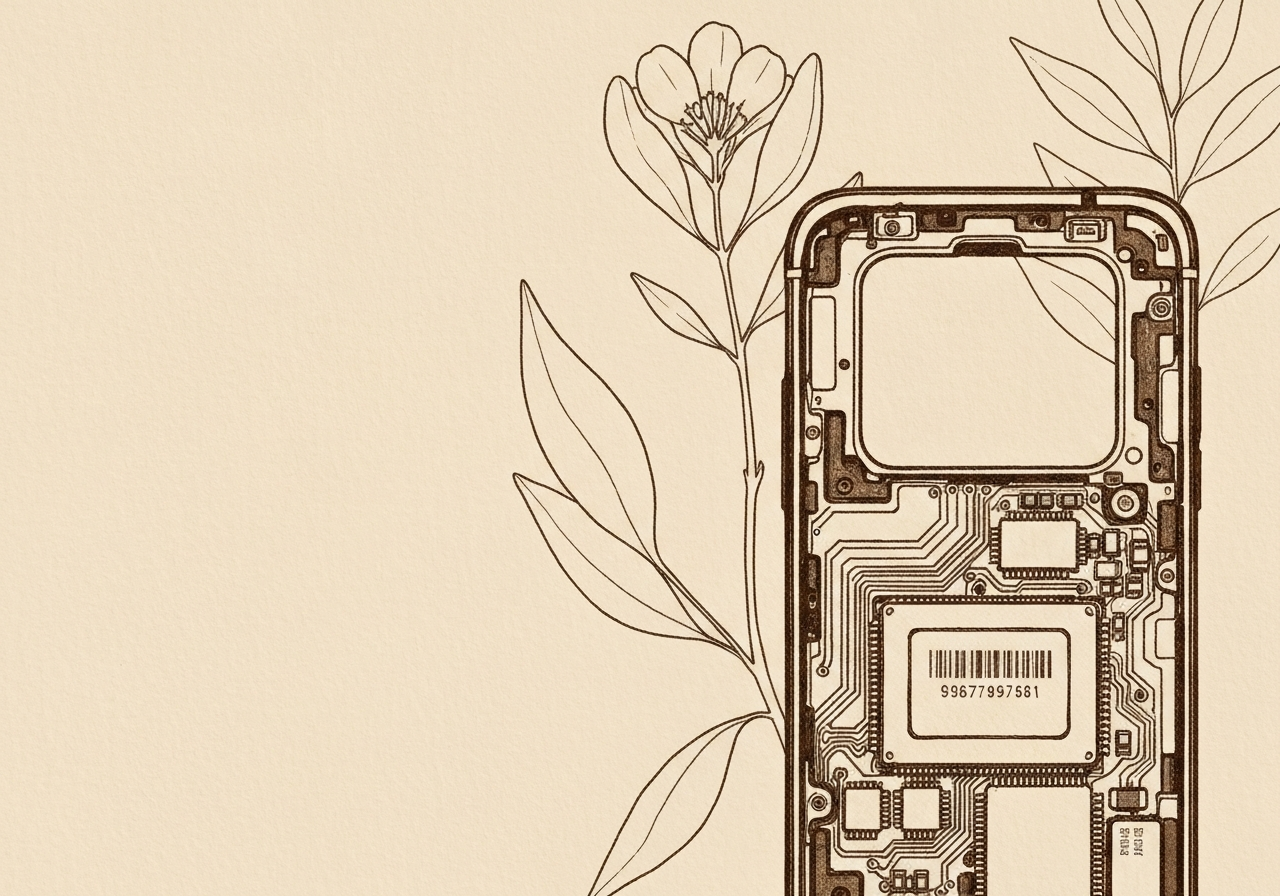
15
digits.
Every mobile has a unique IMEI number. The Supreme Court says that plus cell tower data can put you at the crime scene.
Your phone has a hidden serial number. The Supreme Court just said it can prove where you were.
The courtroom was silent, the only sound the rustle of paper as a judge adjusted his glasses. Mohd Arif was convicted. Not by a witness, not by a confession — but by a string of numbers. The unique ID of his phone, matched to cell tower records, placed him at the crime scene. When he appealed to the Supreme Court, the question was brutally simple: can a machine's memory be trusted to send a man to prison?
This was the central issue in Mohd Arif v State (NCT of Delhi), an appeal against conviction where the Supreme Court examined the reliability of Call Details Records (CDR) and device identification numbers for connecting an accused to a crime. The case pitted Mohd Arif (the appellant/accused) against the State of NCT of Delhi (the prosecution). At stake was whether digital evidence — cold, automated, and impersonal — could carry the same weight as a human witness.
When the phone became the witness
Every mobile phone has two identities. One you choose — the SIM card, linked to your phone number. The other you never see — the IMEI (Instrument Manufactured Equipment Identity), a 15-digit serial number burned into the device at the factory. No two phones share it. The printed CDR log, thick and smelling of ink, held this number alongside every call Mohd Arif had made — a digital shadow of his movements.
The prosecution's case rested on these Call Details Records — the digital log that every mobile network generates automatically. These records don't just show who called whom. They show which cell tower handled each call, and therefore, roughly where the phone was at that moment.
The defence argued: a SIM card can be swapped. A phone can be borrowed. How could the state prove that Mohd Arif himself was holding the device?
The Supreme Court, however, looked deeper — into the very architecture of how a mobile network operates. The court noted that an active mobile phone consists of two components: the mobile instrument and the SIM card. Every mobile instrument possesses a unique identification number — the IMEI. The SIM card is linked to a generated mobile number once activated. These two components are recorded independently by the network, making it possible to link a specific device to a specific subscriber at a specific time.
The invisible architecture of a phone call
When you make a call, your phone talks to a nearby tower — a Base Trans-receiver Station (BTS) — which assigns a unique Cell ID to your session. That tower routes your call through a central computer called the Mobile Switching Centre (MSC).
The MSC is the network's brain. It records everything: the day and time, the duration, the calling and called numbers, the Cell ID of the tower, and crucially, the IMEI number of the device. Every movement of an active phone is logged — not because anyone is watching, but because the network needs this data to function. The court examined this technical functioning in detail, recognising that the system manages data via BTS towers and that a mobile continuously selects a cell (identified by a unique Cell ID) and exchanges data with the corresponding BTS.
Even when you're not on a call, your phone periodically checks in with nearby towers. Each check-in leaves a digital footprint. The court observed that the MSC records every movement of an active mobile phone, including the day and time of the call, duration of the call, calling and the called number, location of the subscriber during the active call, and the unique IMEI number of the instrument used. This is not surveillance — it is the fundamental mechanics of how cellular networks operate.
What the court was asked to decide
The prosecution said yes — the system is automated, tamper-proof in normal operation, and records data that no human could fabricate across thousands of calls. The defence countered: the data could be wrong. A phone might connect to a distant tower. The IMEI might belong to a different device if the record was corrupted. Without a witness who saw Mohd Arif at the scene, the numbers alone shouldn't convict.
But the court looked at how the system actually works. The IMEI is not a label that can be changed by the user. It's burned into the phone's hardware. The SIM card is separate — it carries the mobile number. But the network records both, independently. If a call log shows a specific IMEI and a specific SIM card together at a specific Cell ID at a specific time, the probability of coincidence is vanishingly small.
The Supreme Court relied on this technical functioning to establish the importance and reliability of network records (CDR) in criminal proceedings. The court's logic was precise: since the mobile switching centre handles and records all necessary identification and activity data, including IMEI and location approximated via Cell ID, these network logs are crucial for digital evidence collection and proving the facts of the case.
Why the numbers held up
The Supreme Court accepted the technical functioning of the mobile network as a matter of law. Since the Mobile Switching Centre handles and records all necessary identification and activity data — including the IMEI and location approximated via Cell ID [102, 103, 257–259] — these network logs are crucial for digital evidence collection. The court held that the records are reliable because they are generated automatically, without human intervention, as part of the network's normal operation.
This doesn't mean every CDR is infallible. The court's reasoning was narrower: the system itself is trustworthy. The data it produces can be admitted as evidence, and it is for the accused to show specific tampering or error. In the absence of such evidence, the records stand. The court's findings, as recorded at paragraphs 102, 103, and 257–259 of the judgment, summarised the fundamental basis upon which courts accept location and identity evidence derived from cellular networks.
As the court noted, the mobile switching centre handles and records all necessary identification and activity data, including IMEI and location approximated via Cell ID. This establishes network evidence, particularly logs containing IMEI and location data, as critical components for proving facts in court.
The practical consequence
For lawyers and investigators, this judgment settles a long-standing doubt. A CDR showing a phone's IMEI and Cell ID is not just a clue — it is proof. It can place a person at a location with enough precision to support a conviction, provided the records are properly preserved and presented. The judgment establishes network evidence, particularly logs containing IMEI and location data, as critical components for proving facts in court.
For the rest of us, the implication is uncomfortable. Your phone is not just a communication device. It is a tracking device that you carry voluntarily, that logs your movements automatically, and that the law now trusts more than a human witness. The judge's glasses caught the light as he read the final paragraphs — the phone never lies, the court seemed to say. It doesn't forget. It doesn't get confused. It just records.
The judgment in Mohd Arif v State (NCT of Delhi) is not about one man's guilt or innocence. It is about the quiet, invisible infrastructure that surrounds us every day — the towers, the switching centres, the 15-digit serial numbers — and how that infrastructure has become a silent witness in every criminal case involving a mobile phone.
THE PLAY: In any criminal case involving a mobile phone, demand the complete CDR including IMEI and Cell ID — the network's own records are now judicially recognised as reliable evidence of location and identity. The specific paragraphs [102, 103, 257–259] of the Mohd Arif v State (NCT of Delhi) judgment provide the legal foundation for this argument.
The phone never lies. It doesn't forget. It doesn't get confused. It just records — and the Supreme Court has now said that recording is enough.