Your WhatsApp chats may be useless in court without this one document
Supreme Court settles the law on electronic evidence: a simple certificate can make or break your case. Here's why.
"Without it, the court cannot even look at the evidence."
The Supreme Court on the Section 65B(4) certificateArjun Panditrao Khotkar v. Kailash Kushanrao Gorantyal And Ors — 2020 SCC OnLine SC 571
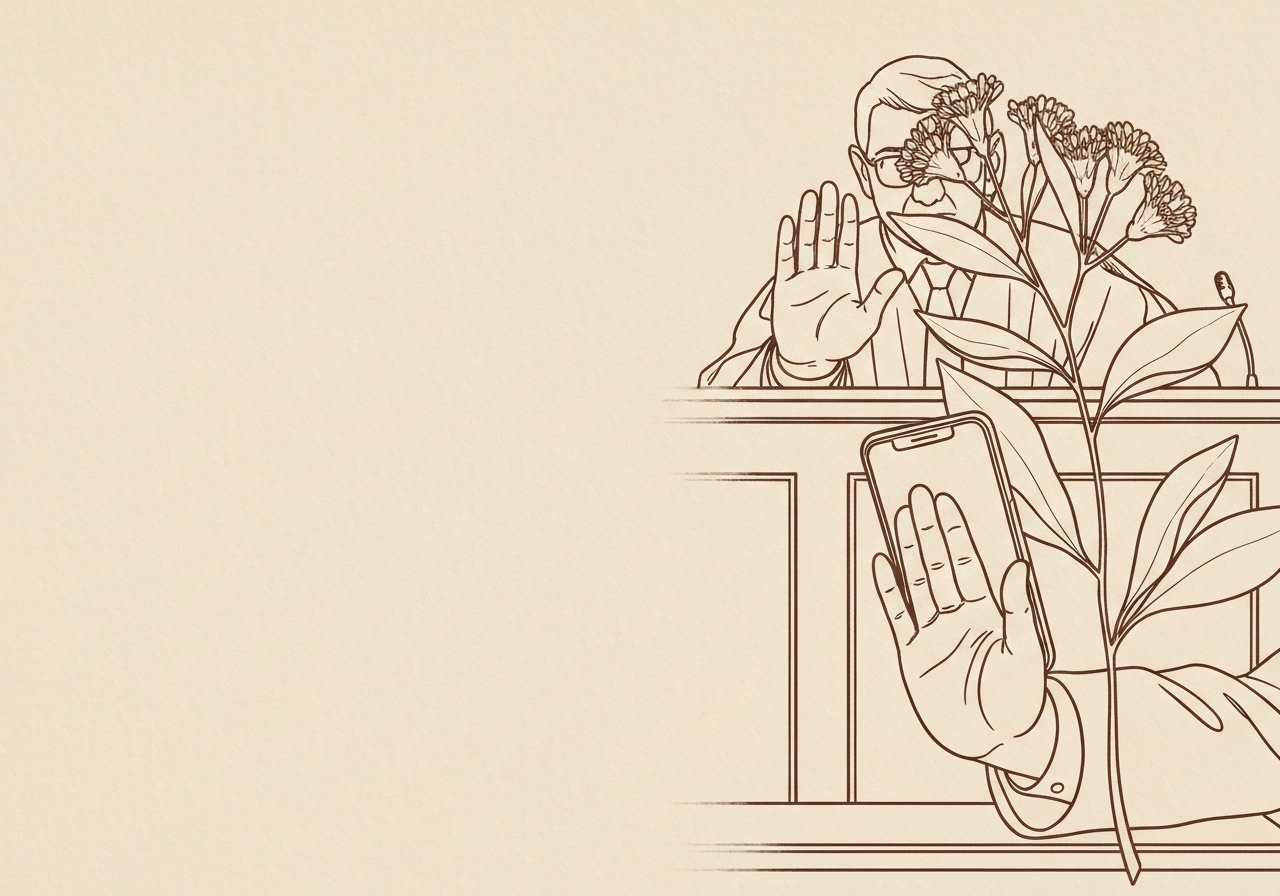
Supreme Court settles the law on electronic evidence: a simple certificate can make or break your case. Here's why.
You have a screenshot that proves everything. But the court won't even look at it — unless you have one piece of paper. The Supreme Court has just shut the door on a decade of confusion, and the message is brutal: your WhatsApp chats, your emails, your call records — they are all legally invisible without a single certificate under Section 65B(4) of the Indian Evidence Act.
When two judges said opposite things
For years, lawyers argued about how to get electronic records into court. Two Supreme Court judgments — Anvar P.V. v. P.K. Basheer and Shafhi Mohammad — left everyone guessing. Some courts accepted printouts without a certificate. Others demanded one. Litigants lost cases not because the facts were weak, but because the paperwork was wrong.
Then came Arjun Panditrao Khotkar v. Kailash Kushanrao Gorantyal And Ors. A three-judge bench was asked one question: is the Section 65B(4) certificate mandatory, or can you get around it?
The one document that changes everything
Section 65B of the Evidence Act is a special rule for electronic records — things stored on computers, phones, CDs, pen drives, servers. The law says: if you want to use a printout of an electronic record as evidence, you must also produce a certificate signed by a person who was in charge of the computer when the record was created.
That certificate must state — in writing — that the computer was working properly, that the record was generated in the ordinary course of business, and that the printout is an accurate copy. Without it, the court cannot even look at the evidence.
The Supreme Court in Khotkar made this crystal clear: the certificate is not optional. It is the only key that unlocks the door.
Why the court drew a line in the sand
The bench looked at two earlier judgments that had created the mess. In Anvar P.V. (2014), the court had said the certificate was mandatory. But in Shafhi Mohammad (2018) and Tomaso Bruno (2015), other benches had suggested that electronic records could be admitted without the certificate, using other provisions of the Evidence Act.
The Khotkar bench overruled those later judgments. It held that Anvar P.V. was the correct law all along. The court observed that Section 65B of the Evidence Act has overcome the problems of Primary vs. Secondary evidence with regard to electronic records. The logic is that electronic records are not physical documents you can bring to court. A computer server is not a piece of paper. So Parliament created a special procedure — the certificate — to make electronic records admissible as documents, provided certain conditions are met.
The court's own words were clear: Section 65B makes admissible, as a document, a paper printout of electronic records stored in optical or magnetic media produced by a computer, subject to the fulfillment of the conditions specified in sub-section (2) of Section 65B.
The logic is simple. If the owner of the laptop or phone walks into court, takes the witness stand, and says "this is my device, I created this record, I am producing the original" — then no certificate is needed. The original electronic document is being produced by its owner.
But in most real-world cases — bank records, call logs, WhatsApp backups, emails from a company server — the "computer" is part of a system. You cannot physically bring the server to court. The only way to present that information is through a printout, and that printout must be accompanied by the Section 65B(4) certificate.
What this means for your WhatsApp chats
Here is where the ruling hits home. Imagine a courtroom in a small city. The lawyer for the plaintiff — a woman who claims her husband's family demanded a dowry — holds up her phone. The screen glows in the dim light of the chamber. "Here," she says, "is a WhatsApp chat where the husband admits to the demand. I have a screenshot." The judge leans forward. The courtroom is silent. Then the opposing counsel stands. "My Lord," he says, "this is electronic evidence. Where is the Section 65B(4) certificate?" The judge pauses. The glow of the phone screen seems to dim. "Inadmissible," the judge says quietly. The weight of the moment settles like a stone.
Under Khotkar, the objection is valid. A screenshot is a copy of an electronic record. Unless you can produce the phone itself and testify that you took the screenshot, or unless you get a certificate from the person who controls the WhatsApp server — good luck with that — the court will not consider it.
The same applies to emails, bank statements downloaded from a portal, call detail records from a telecom company, CCTV footage from a shop, or any data retrieved from a hard drive. Without the certificate, it is as if the evidence does not exist.
The practical problem the court acknowledged
The bench was not blind to the difficulty. In many cases, the person who can sign the certificate — the system administrator, the bank manager, the telecom engineer — is not a party to the lawsuit. They may be hostile, uncooperative, or simply unavailable.
The court addressed this by saying: if the original electronic device is produced in court by its owner or custodian, and that person testifies about its operation, the certificate is not needed. But if the record comes from a system that cannot be physically produced — a bank's central server, a telecom company's data centre — the certificate is the only route.
This creates a harsh reality. If you are suing a bank and need your account statements, you must get the bank to issue a Section 65B(4) certificate. If the bank refuses, your evidence is blocked. The court cannot force the bank to cooperate — it can only draw an adverse inference (assume the evidence would have hurt the bank) if the bank withholds the certificate without good reason.
But an adverse inference is not the same as admissible evidence. You still cannot use the printout to prove your case.
How to block the other side's electronic evidence
For lawyers and litigants on the receiving end, Khotkar is a powerful weapon. If the other side produces a printout of an email, a WhatsApp chat, or a bank statement without a proper Section 65B(4) certificate, you can object immediately. The court must exclude that evidence.
The judgment also clarified that the certificate must be obtained at the time the evidence is produced in court. You cannot get it later. If the certificate is missing, the evidence is inadmissible from the start.
This forces parties to be disciplined about evidence gathering. Before filing a case, you must identify every electronic record you plan to use and ensure you have the certificate ready. If you are relying on records from a third party — a bank, a hospital, a telecom company — you must request the certificate in writing, well before the trial begins.
The one exception that proves the rule
The court carved out a narrow exception. If the person who controls the computer system is a party to the case and refuses to produce the certificate, the court can draw an adverse inference against that party. But the court cannot admit the electronic record without the certificate — even if the refusal is deliberate.
This means the certificate is not just a procedural formality. It is the only way to make an electronic record speak in court. Without it, the record is silent.
Why this judgment matters for every Indian with a phone
We live in a world where most evidence is born digital. A contract signed on email. A threat sent on WhatsApp. A payment made through UPI. A photograph taken on a phone. Every one of these is an electronic record.
Khotkar tells us that the law has caught up with technology — but not in the way most people expect. The law does not say "anything digital is automatically admissible." It says the opposite: anything digital is inadmissible unless you follow a specific, technical procedure.
For advocates, CFOs, founders, doctors, and journalists reading this: your next case may turn on a single piece of paper you did not think to get. A certificate under Section 65B(4) is not a lawyer's technicality. It is the difference between winning and losing.
THE PLAY: Before you file any case involving electronic records — emails, WhatsApp chats, bank statements, CCTV footage, call logs — obtain a signed Section 65B(4) certificate from the person who controls the computer system that generated the record. Without it, your evidence is legally invisible.
The court ended where it began: with a piece of paper that holds more power than a thousand screenshots.